

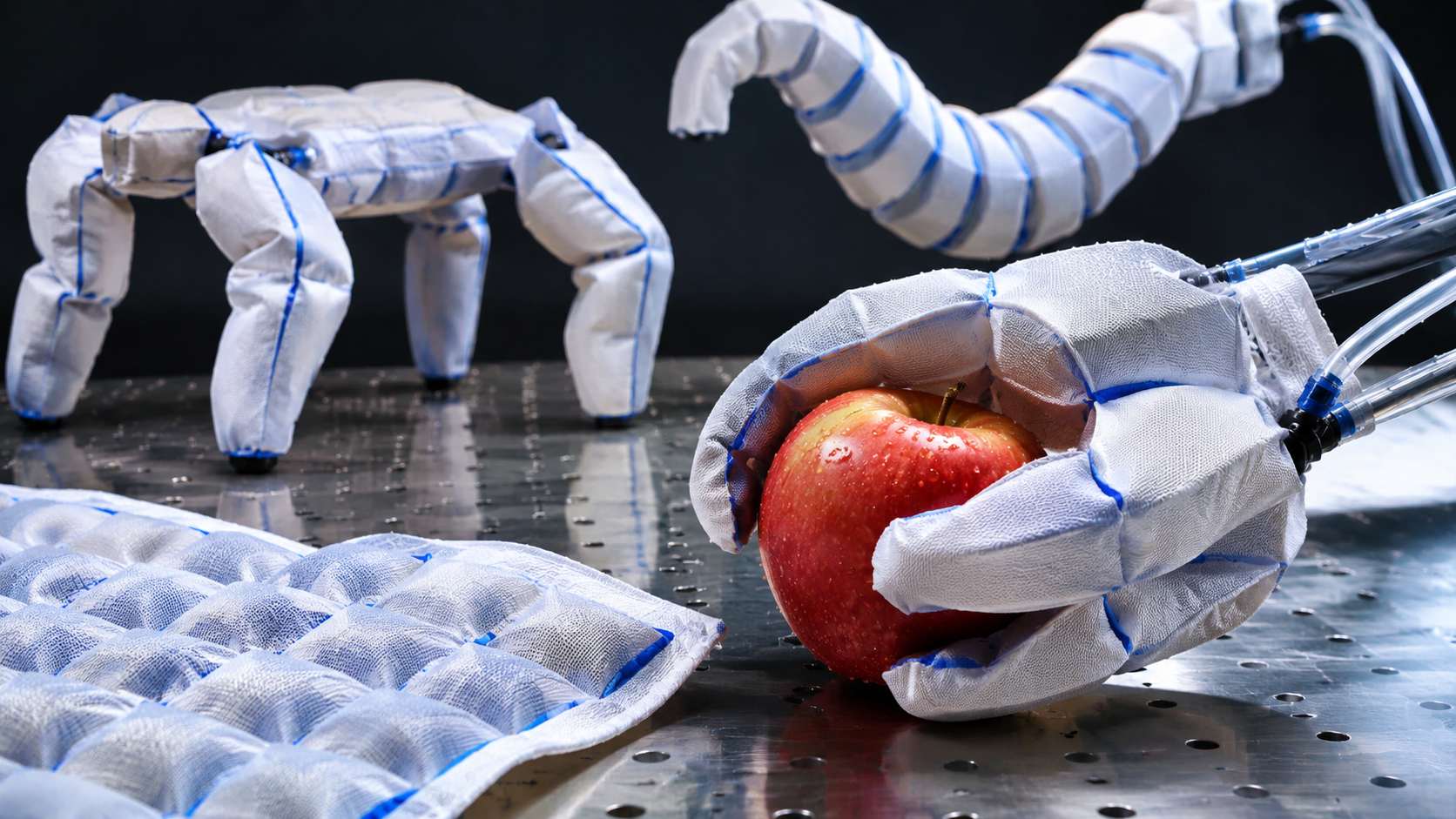
With scissors, a soldering iron and a stapler, Michigan engineers can transform a single sheet of fabric into robotic muscles, mechanical grippers and walking machines.
ANN ARBOR, Mich. — University of Michigan engineers have developed an inflatable fabric that could change how robots are designed, manufactured and repaired. The technology could eventually find applications in health care, industrial manufacturing, agriculture and robotics education.
The material, called FaBrick, contains a network of interconnected air chambers that expand when pressurized. By modifying the fabric, researchers can produce mechanical movements that mimic the actions of human muscles and joints.
Michigan Engineering announced the technology’s development on Nov. 24, 2026. The underlying research was published in the peer-reviewed journal Science Advances, with financial support from the National Science Foundation.
Building Robots From a Roll of Fabric

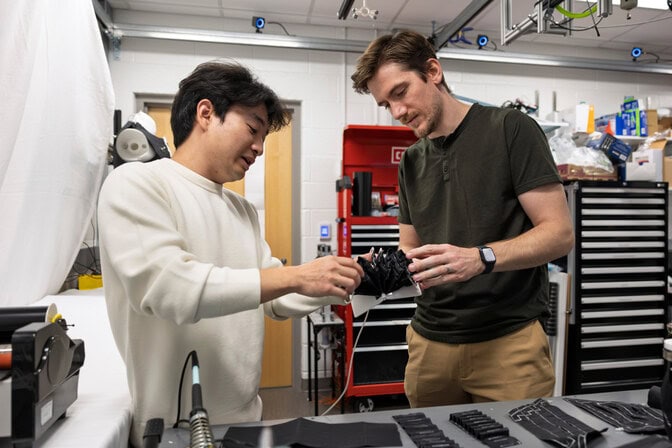
Conventional industrial robots typically rely on metal frames, electric motors, gears and mechanical joints. Soft robotics takes a different approach, using flexible materials to create machines capable of adapting to their surroundings.
However, manufacturing these flexible components often requires specialized equipment. Engineers may spend considerable time developing individual parts before assembling and testing a complete robot.
The Michigan team addressed that problem by developing a standardized material that can be modified to perform five fundamental movements: contraction, bending, twisting, rotation and stiffening.
Mingyuan Li, a U-M mechanical engineering doctoral student and the study’s lead author, described FaBrick as an alternative to developing separate manufacturing methods for each type of robotic movement.
How Michigan’s Inflatable Robot Fabric Works

FaBrick uses two layers of fabric coated with thermoplastic polyurethane, a flexible synthetic material commonly used in protective and waterproof products.
The researchers developed a continuous manufacturing system that bonds the fabric layers using heated rollers. The resulting material contains rectangular air pockets connected through small channels.
When compressed air enters a pocket, its shape changes and its effective length decreases. Arranging multiple pockets in different configurations allows engineers to control the direction and strength of the resulting movement.
Users can cut the fabric to size, seal selected air channels and fold or staple sections together. This allows the same material to serve different mechanical functions without requiring a separate manufacturing process for each component.
The process also supports continuous production, potentially allowing manufacturers to produce large rolls of inflatable robot fabric for different applications.
Robots Built From the Same Inflatable Fabric
The University of Michigan research team demonstrated several practical applications for FaBrick. Each prototype illustrates how flexible robotic components can perform different tasks using the same basic material.
Wearable Robotic Assistance Sleeve
Researchers developed a lightweight wearable device designed to assist movements involving the shoulder, elbow and wrist. Future versions could support patients undergoing physical rehabilitation without requiring bulky mechanical equipment.
Flexible Robotic Gripper
An inflatable grasping mechanism adjusts to objects of different shapes and sizes. Unlike rigid mechanical grippers, the fabric conforms to the object it holds, potentially making it useful for handling fragile products.
Four-Legged Walking Robot
The team constructed a robot with four flexible legs that move through controlled air pressure. By selectively contracting sections of each leg, the machine can bend its limbs and take steps.
Lightweight robots of this type could eventually operate on irregular surfaces where conventional rigid machines encounter difficulties.
Potential Applications for Michigan Manufacturing
The technology could have particular significance for Michigan’s manufacturing economy, where automation has long played a central role in automotive production.
Flexible robotic grippers could potentially handle delicate components that conventional machinery struggles to manipulate. Food processors and agricultural businesses might also benefit from machines capable of handling produce without damaging it.
For smaller Michigan manufacturers, the ability to develop specialized robotic components without investing in custom molds or complex fabrication machinery could make experimental automation projects more affordable.
Michigan schools, community colleges and technical training programs could also use the material to introduce students to robotics without requiring extensive manufacturing facilities.
These remain potential applications rather than demonstrated commercial deployments.
Could Inflatable Robots Help Patients Recover?
Wearable robotics represents another possible market for inflatable robot fabric.
Lightweight devices made from FaBrick could eventually assist patients undergoing physical therapy following strokes, injuries or surgery. Unlike heavy mechanical assistance systems, fabric-based equipment could offer greater flexibility and comfort.
The university also identified possible applications for patients with Parkinson’s disease and other conditions affecting physical movement.
However, the Michigan study was an engineering investigation, not a clinical trial. Researchers have not established whether FaBrick-based medical devices improve patient outcomes or meet applicable medical safety requirements.
Making Robotics More Accessible
Daniel Bruder, an assistant professor of mechanical engineering at U-M and senior author of the study, said the manufacturing approach shifts much of the fabrication work into the initial production of the fabric.
Instead of learning several specialized manufacturing techniques, users could develop different robotic devices by modifying a common material with ordinary tools.
The approach could make experimental robotics more accessible to high school students, independent inventors and businesses that lack advanced engineering facilities.
It could also allow engineers working outside traditional laboratories to construct or modify robotic components as needed.
From University Laboratory to Commercial Production
The university has applied for patent protection with assistance from U-M Innovation Partnerships. Researchers are seeking commercial partners to bring the technology to market.
Several technical questions remain. Industrial production costs, long-term durability and performance outside controlled laboratory environments warrant additional testing. Practical applications will also require reliable air supplies and control systems.
The immediate achievement is not a commercially available robot. It is a common manufacturing platform from which many different robotic devices can be built.
For a state that helped establish modern assembly-line manufacturing, Michigan’s latest robotics research raises an interesting possibility: Some of the machines working in tomorrow’s factories may begin as rolls of cloth.
Frequently Asked Questions About Inflatable Robot Fabric
What is FaBrick?
FaBrick is an inflatable fabric developed by University of Michigan engineers. It contains interconnected air chambers that can be configured to produce different mechanical movements when supplied with compressed air.
What can inflatable robot fabric be used for?
Potential applications include industrial grippers, wearable rehabilitation devices, flexible walking robots, agricultural automation and robotics education. Researchers have demonstrated several working laboratory prototypes, but commercial applications require further development.
Is FaBrick commercially available?
As of November 2026, the University of Michigan research team has applied for patent protection and is seeking commercial partners. The university has not announced a general commercial release or retail price.
How does FaBrick differ from traditional robots?
Traditional robots generally rely on rigid components and mechanical joints. FaBrick uses flexible, air-powered chambers that can produce movement while conforming to objects and surfaces.
📚 Works Cited for Inflatable Robot Fabric
- DeLacey, Patricia. “Soft Robotics: Actuated Fabric Lowers the Barrier to Entry.” Michigan Engineering News, University of Michigan, 24 Nov. 2026.
- Li, Mingyuan, et al. “FaBrick: An Actuated Fabric Building Platform for Constructing Scalable and Versatile Soft Robots.” Science Advances, American Association for the Advancement of Science, 2026. DOI: 10.1126/sciadv.aeg1614.




